Understand the chart
Learn candlesticks, support & resistance, and indicators like RSI — explained in plain language by Claude, on demand.
Learn the markets. Master your risk. Build real skill.
Education only — trading carries real risk of loss. Always practice on a demo first.
Most beginners lose because they skip the boring parts — analysis, risk, and routine. We use Claude AI to make those parts simple and repeatable.
Learn candlesticks, support & resistance, and indicators like RSI — explained in plain language by Claude, on demand.
Position sizing, the 1–2% rule, and bankroll discipline — the skills that actually keep traders in the game.
Use Claude as a tutor and reviewer to study your own trades, quiz yourself, and steadily improve your decisions.
A simple loop you can repeat for every session — learn, plan, review.
Ask Claude to explain any setup or indicator with examples until it clicks. No question is too basic.
Set your max risk per trade, define entry rules, and size your position before you ever click trade — on demo.
Paste your trade journal into Claude to spot patterns, fix mistakes, and tighten your strategy over time.
Snapshots from study sessions — exactly the kind of analysis you'll learn to run yourself.
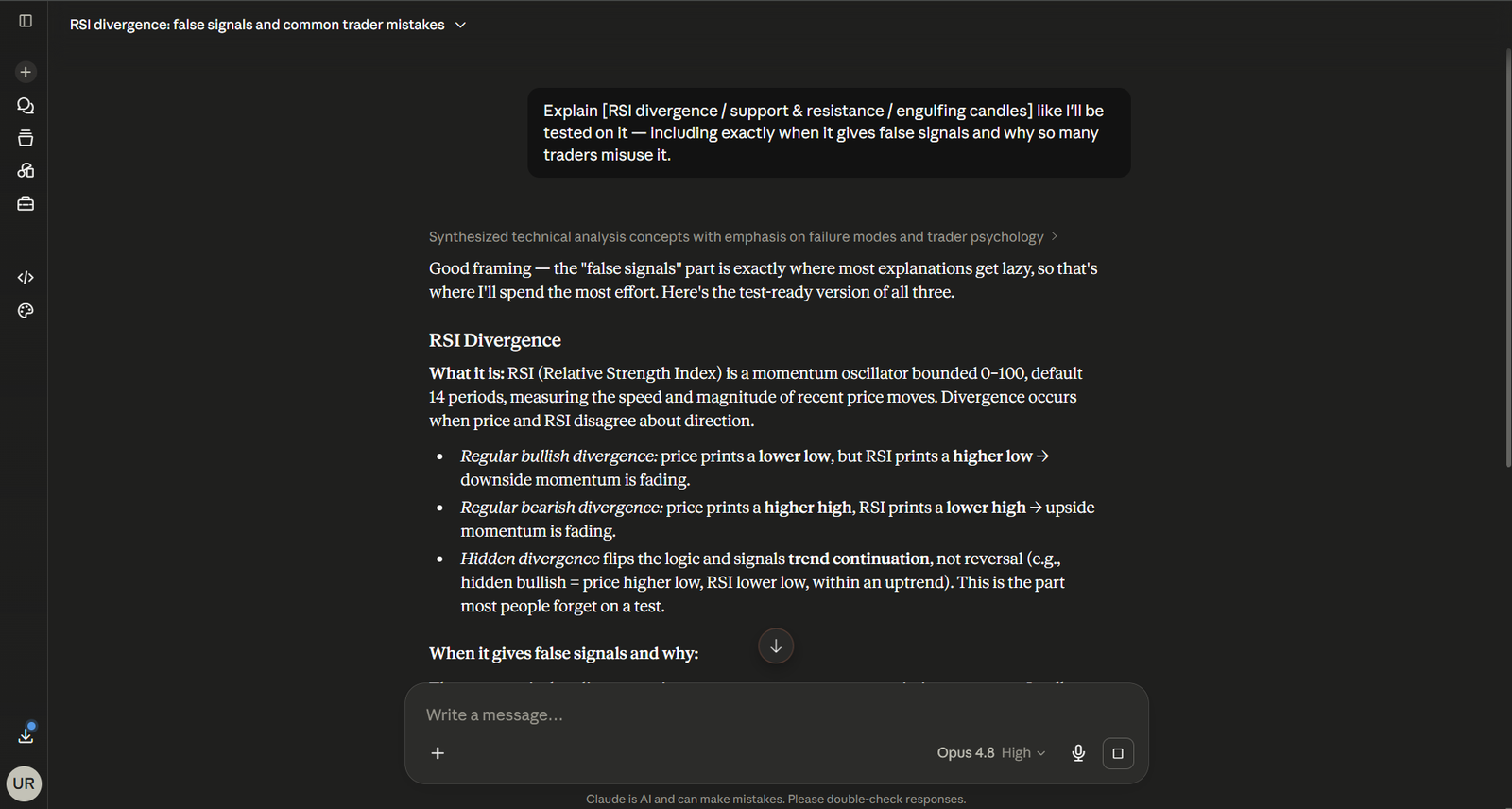
"I kept getting faked out by RSI. Claude broke down why divergence fails and what to confirm first. Total game-changer for my study routine."
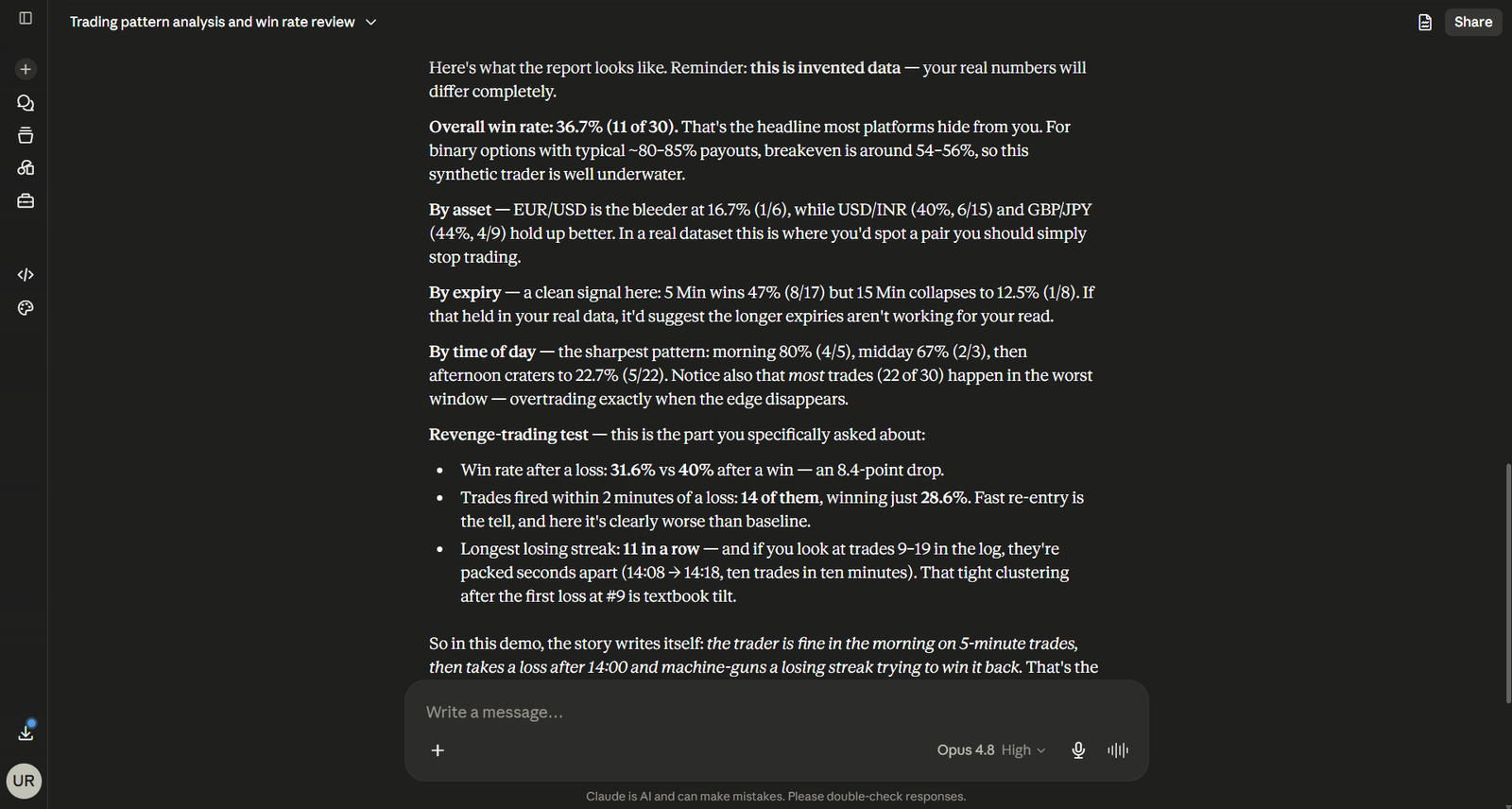
"I pasted my last 20 trades and Claude found the one pattern that was draining my account. Fixing that single habit changed everything."
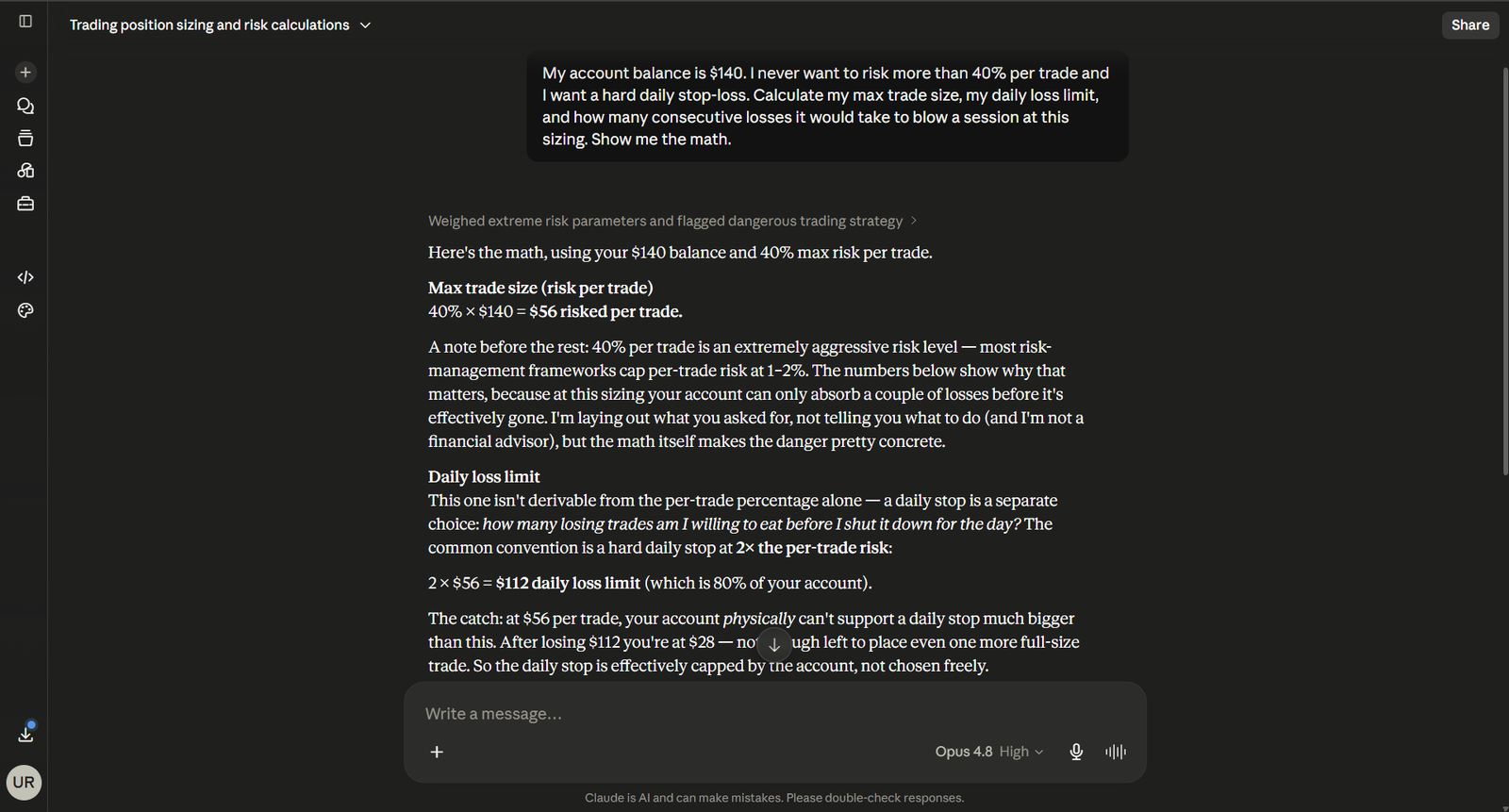
"Risk math used to scare me. Now Claude sizes every position around my balance and the 2% rule in seconds. I finally feel in control."
Copy any prompt, paste it into Claude, and replace the [brackets] with your own details. These build skill — they're not "tell me the winning trade."
A clear, honest walkthrough — what to learn, in what order, and how an AI study partner fits in.
This learning platform is built for ordinary people who want to understand short-term, fixed-time trading on Quotex without drowning in jargon. Maybe you've watched a few videos, opened a demo account, and felt overwhelmed by indicators and contradicting advice. That's normal. The goal here is not to sell you a shortcut to riches — it's to give you a calm, structured way to build genuine skill, using Claude AI as a patient tutor that's available whenever a question pops into your head.
If you're looking for a magic button that prints money, this isn't it, and you should be deeply skeptical of anyone who promises one. If instead you're willing to study a little every day, practice on a demo before risking real money, and treat trading like a skill rather than a slot machine, you're in exactly the right place. Start with our full Trade-with-Claude guide and work through it at your own pace.
Quotex is a platform for fixed-time (often called binary or digital) trading. The basic idea is simple: you predict whether the price of an asset — a currency pair, a crypto, a commodity — will be higher or lower after a set period of time. If you're right, you receive a fixed payout; if you're wrong, you lose the amount you committed to that trade.
That simplicity is exactly why it's risky. The all-or-nothing structure means losses come quickly and can compound if you're undisciplined. Be honest with yourself about this from day one: the majority of retail traders lose money, and the difference between those who last and those who blow up their accounts usually isn't a secret indicator — it's risk management and emotional control. Treat your demo account as a real training ground and only consider real funds once you've shown consistency over many sessions. If you don't have an account yet, you can join Quotex here and start on demo.
Reality check: No tool, signal, or AI can tell you the future of the market. Anything that claims a guaranteed win rate is misleading. Claude's value is in helping you think and learn better — not in predicting outcomes.
Most beginners learn trading by jumping between random videos and forum posts, picking up fragments that never quite fit together. An AI assistant like Claude changes that because it can adapt to you. You can ask it to explain the same concept three different ways until it clicks, quiz you on what you just learned, review your own trades, and pressure-test your strategy for weaknesses — all in plain language, on demand.
Think of Claude as a tireless tutor and a second pair of eyes, not an oracle. Used well, it can compress months of confused self-study into a focused, structured routine. Used badly — by asking it to "predict the next candle" — it'll just disappoint you, because that's not what it (or anything) can reliably do. We explain the difference in detail on why Claude is better for trading education.
Before any strategy or indicator, you need to read price itself. Start with candlesticks — each one tells a small story about who won that period, buyers or sellers. Learn the handful of patterns that actually carry weight (engulfing candles, pin bars, inside bars) and ignore the long tail of exotic patterns that rarely matter in practice.
Next comes structure: support and resistance. These are simply the price levels where the market has repeatedly turned before. Most beginner setups become far clearer once you can mark these levels confidently, because they tell you where a move is likely to stall or accelerate. Ask Claude to walk you through identifying them on a chart you describe — prompt #9 in the pack above is built for exactly this.
Only after structure should you add indicators, and even then, keep it minimal. RSI (Relative Strength Index) is a popular momentum tool, but it's also one of the most misused. A common mistake is treating an "overbought" reading as an automatic sell signal — in a strong trend, price can stay overbought for a long time while the impatient trader gets run over. This is why understanding divergence, and the false signals that come with it, matters so much. For a focused breakdown of which assets behave most cleanly with these tools, see our guide to the best pairs on Quotex.
If you only master one thing from this entire platform, make it this section. From a finance perspective, trading success is far less about being right often and far more about controlling how much you lose when you're wrong. A trader who wins 55% of the time but risks wildly will still go broke; a disciplined trader who wins 50% but protects their capital can survive and grow.
Never risk more than 1–2% of your total account balance on a single trade. If your balance is small, this will feel painfully slow — that's the point. The slow path is the one that keeps you in the game long enough to actually get good. With a £/$500 balance and a 2% rule, your maximum risk per trade is just £/$10. Claude can run these numbers with you in seconds (that's prompt #5), but the discipline to follow them is on you.
Decide before you start how much you're willing to lose in a session, and how many trades you'll take. When you hit either limit, you stop — no exceptions, no "just one more to win it back." This single rule prevents more account blow-ups than any indicator ever could.
Stop chasing individual wins and start thinking in terms of expectancy — your average result per trade across many trades. A strategy is only worth trading if, over a large sample, it makes more than it loses after accounting for payout rates. Claude is excellent at helping you frame this maths honestly so you don't fool yourself with a lucky week. Pair this thinking with the structured systems on our best strategy for Quotex page.
CA's note: Treat your trading account like a business with a strict budget. Only ever fund it with money you can genuinely afford to lose, keep records, and never borrow to trade. Discipline with capital is the real edge.
Here's a repeatable loop you can run with Claude for every session. It's deliberately boring — boring is what works.
Do this consistently and your improvement compounds. Skip the review step and you'll repeat the same mistakes for months. The traders who get good are simply the ones who close this loop, week after week.
The prompt pack above is your starting toolkit. Each one is a template — wherever you see [brackets], replace the text with your own numbers, rules, or chart description, then paste it into Claude. Begin with prompt #1 to build your curriculum, use #5 every time you think about position size, and make #6 a weekly ritual to review your progress. The more specific and honest your input, the more useful Claude's response will be.
When you're ready to go deeper — with worked examples, full strategy breakdowns, and a structured path from beginner to consistent — head to the complete guide. It ties everything on this page together into one clear roadmap.
The honest answers beginners ask most. For more, see our full FAQs page.
No — and you should distrust anyone who says it can. No AI or tool can reliably predict short-term price moves. Claude's real value is teaching you concepts, reviewing your trades, and helping you build disciplined risk rules so you make better decisions yourself.
Yes. Fixed-time trading is high-risk and most retail traders lose money. Never trade with funds you can't afford to lose, always practice on a demo account first, and treat money management as your top priority.
None at all. The platform is designed for complete beginners. Start with prompt #1 to build a study plan, work through the full guide, and practice everything on a demo account before considering real funds.
For learning, nothing — a free demo account lets you practice with virtual funds. Only fund a real account once you're consistent on demo, and even then, only with money you can comfortably afford to lose.
No. Everything on this platform is educational content to help you build skills and understanding. It is not financial, investment, or trading advice. You are responsible for your own decisions — please trade responsibly.
Grab the full guide, run the 10 prompts, and start practising on demo today. No hype — just a clear path to real skill.
Whether you're stuck on a concept or want guidance on where to start, send us a message and we'll point you in the right direction.
Fill in the form and we'll get back to you shortly.
Risk warning: Trading fixed-time / binary options on Quotex carries a high level of risk and may not be suitable for everyone. You can lose some or all of your invested capital, and the majority of retail traders lose money. All content on this site is for educational purposes only and is not financial, investment, or trading advice. Past performance does not guarantee future results. Please trade responsibly and only with money you can afford to lose.